Introduction: A Paradigm Shift in Software Development
The traditional software development lifecycle (SDLC) is fraught with inefficiency, leading to a high rate of project failure. Industry data reveals a sobering reality: a significant percentage of projects are canceled, exceed their budgets, and deliver features that are never used by end-users [1]. The primary cause of this widespread failure is the requirements gap—the chasm between what stakeholders believe they want and what they actually need. The Mishkin Method directly confronts this challenge by inverting the traditional process, leading to a state of near-zero waste in development.
Instead of gathering requirements in a vacuum, the Mishkin Method begins by building a high-fidelity, interactive prototype. This allows stakeholders to “see, taste, and touch” the final product from day one, ensuring that what is eventually built is what is truly needed. Once the prototype is validated and refined through direct user interaction, the specifications are reverse-engineered from the working model. This ensures that the requirements are a perfect reflection of the desired end-state, leading to a more predictable, efficient, and waste-free implementation phase.
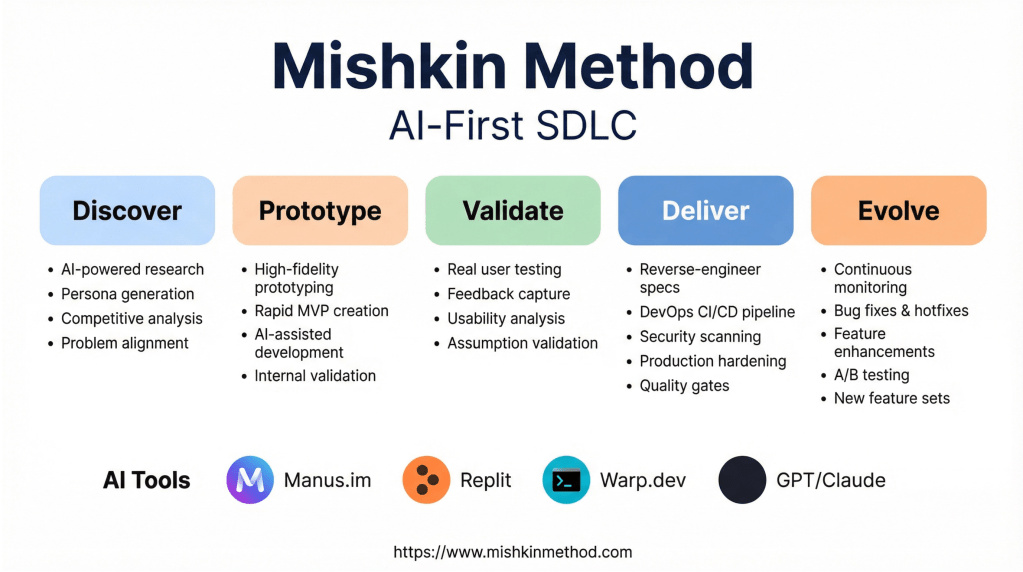
Table of Contents
- The Core Phases of the Mishkin Method
- 1. Discover
- 2. Prototype
- 3. Validate
- 4. Deliver
- 5. Evolve
- The AI-Augmented Development Pipeline
- A Hybrid DevOps Approach
- Legacy System Integration
- Case Study in Action: Building a Mobile App in a Single Day
- Guiding Principles
- References
The Core Phases of the Mishkin Method
The Mishkin Method is structured around five core phases, designed to “pull everything forward” by integrating requirements, design, and user feedback into a single, iterative process.
1. Discover
Goal: To deeply understand the problem, align on desired outcomes, and generate a wide range of ideas.
In this phase, AI is leveraged as a powerful research and analysis partner. Product teams use AI to generate user personas, map out workflows, and identify pain points and goals. Technical teams, in turn, focus on exposing existing system documentation, historical data, and API catalogs in formats that AI can readily ingest and analyze. This initial phase is critical for building a shared understanding of the project and its objectives.
| Role | Responsibilities |
|---|---|
| Product |
|
| Tech |
|
| AI Tools |
|
2. Prototype
Goal: To rapidly create a minimum viable product (MVP) or a high-fidelity prototype of a key feature or flow to gather early feedback.
This phase is where the Mishkin Method diverges most significantly from traditional models. Instead of building from abstract specifications, the team creates a tangible, interactive prototype. This is often accomplished using Replit, which can rapidly develop apps for web and mobile. This allows for immediate user feedback and validation, ensuring that the project is on the right track from the very beginning and rolls easily into future stages. The use of collaborative, in-browser development environments like Replit, further enables unprecedented speed and agility.
3. Validate
Goal: To get feedback early and often, refining the project’s direction based on real user interaction.
Validation is not a one-time event but an ongoing process. The high-fidelity prototype is put in front of real users to validate the user experience and underlying assumptions. Manus.im plays a key role in this phase by performing specification validation, diagramming user journeys from prototypes to visualize the complete user experience, and validating documentation and case studies to ensure accuracy and completeness. For existing systems, Manus.im can dissect complex platforms like WordPress to understand architecture and user flows. AI can also be used to simulate user flows and generate demos, while instrumentation captures valuable usability data. This continuous feedback loop ensures that the final product is not just functional but also intuitive and user-friendly.
4. Deliver
Goal: To productionalize the validated MVP, transforming it into a hardened, secure, and monitored product.
This phase marks the handoff from the prototype to a production-ready system. The focus shifts to hardening the code for security, quality, and performance. A sophisticated, AI-augmented DevOps pipeline is employed to ensure a smooth and predictable path to production. This includes automated security scanning (SNYK), continuous integration and deployment (CI/CD) via Warp.dev, and manual oversight for critical components.
5. Evolve
Goal: To continuously fix, enhance, and expand the product after its initial delivery.
Evolve is the ongoing, post-delivery phase that encompasses bug fixing, performance monitoring, feature enhancements, and the implementation of new feature sets. The same AI-powered tools and collaborative environments used in the initial development process are employed to continually support, adapt, and extend the product. When a substantial new feature set is required, it triggers a full cycle of the Mishkin Method, ensuring that even major additions are developed with the same rigor and efficiency as the original product.
The AI-Augmented Development Pipeline
The Mishkin Method integrates cutting-edge AI tools into a robust and disciplined development process. This hybrid approach combines the speed and efficiency of AI-assisted coding with the rigor and control of traditional SDLC practices. The entire cloud infrastructure, including build pipelines, is generated and managed using AI-powered tools like Warp.dev, which automates complex DevOps tasks.
A Hybrid DevOps Approach
The key stages of the pipeline are as follows:
- Branching Strategy: All development work is performed in feature branches, isolating new code from the main codebase until it is ready for integration.
- AI-Assisted Development & DevOps: AI agents, such as those found in Replit and Manus.im, are used within feature branches to accelerate code generation and bug fixing. The DevOps lifecycle is heavily automated, with tools like Warp.dev used to generate and manage all cloud infrastructure and build pipelines.
- Pull Request and Code Review: Once a feature is complete, a pull request (PR) is created to merge the code into the development branch. This triggers a manual code review process, ensuring that all code is inspected by a human before it is integrated.
- Automated Security Scanning: As part of the PR process, automated security scans are performed using AI tools to identify potential vulnerabilities and even generate prompts for remediation.
- Continuous Integration and Deployment (CI/CD): Once a PR is approved and merged, a CI/CD pipeline—generated and managed by Warp.dev—automatically builds the code, runs tests, and deploys it to a production environment.
- Manual Oversight for Critical Components: While the pipeline is highly automated, manual oversight is maintained for critical components such as SQL database changes, secrets management, and infrastructure configurations.
Legacy System Integration
The Mishkin Method provides a strategic approach to integrating with legacy systems by building REST-based API layers with mock endpoints that mirror real schemas. This enables safe development and testing before touching production systems, mitigating the risks associated with a lack of documentation, fragile architectures, and testing constraints.
Case Study in Action: Building a Mobile App in a Single Day
A compelling demonstration of the Mishkin Method’s power is the development of a full-featured native iOS/Android mobile application for PlayerDB in a single development session. Using Manus.im to connect to the existing GitHub repository and leverage the API-first architecture, the mobile app was rapidly developed as a pure API client, consuming the same endpoints as its web counterpart. This API-first approach, a core tenet of the Mishkin Method, resulted in:
- Zero backend duplication: No mobile-specific API endpoints were needed.
- Consistent business logic: All rules were enforced server-side.
- Simplified testing: The backend had already been validated by the web app.
- Reduced maintenance: A single API codebase served both platforms.
The entire mobile app integration required only minimal backend changes, totaling approximately 25 lines of code. This remarkable efficiency was made possible by the principles of the Mishkin Method, which prioritize clean separation of concerns and the use of modern, API-first architectures.
Guiding Principles
- AI is a teammate, not just a tool.
- Product leads with clarity, not specs.
- Tech builds for reuse.
- Real users, real feedback.
- Evolve never ends.
 Mishkin Consulting Services